CASE BLUE: GERMAN 1942 SUMMER OFFFENSIVE by Joni Nuutinen
LINKS:
⊕ Play Store
⊕ Amazon
⊕ free
⊕ local apk
In spring 1942 Wehrmacht was preparing to launch Case Blue, the strategic summer offensive on the Eastern Front. The plan outlined advance to Stalingrad and then the main force would turn south and drive to Caucasus to seize the oil fields of Maykop, Gorzny, and Baku.
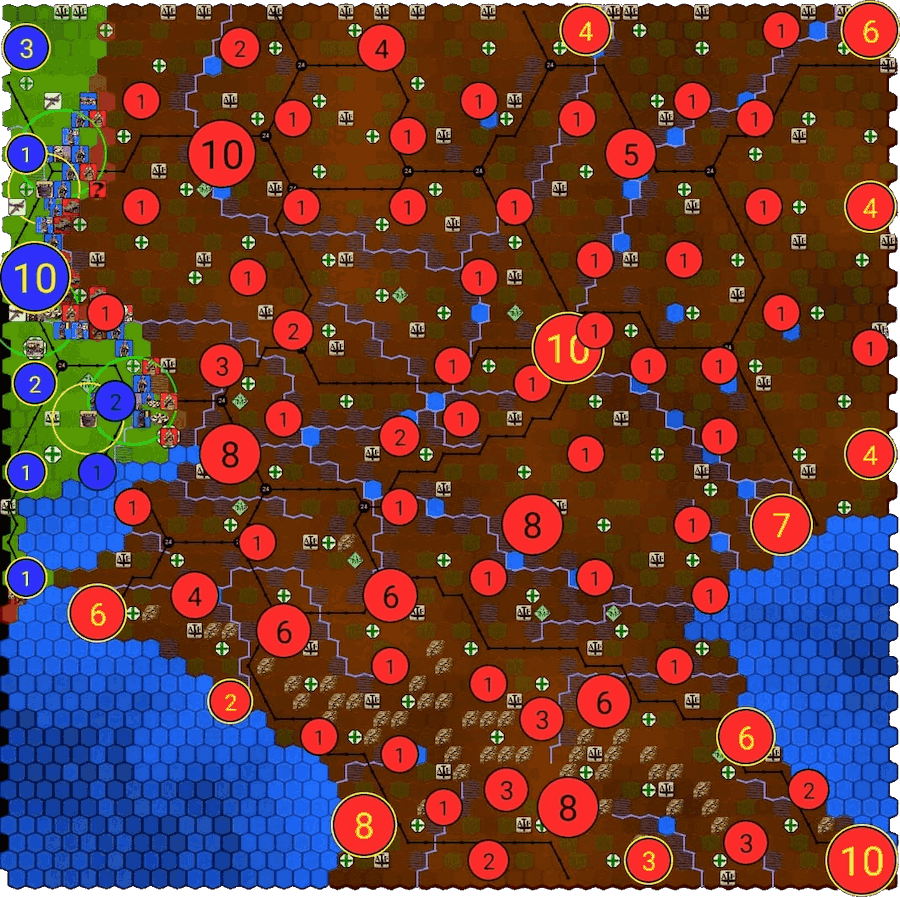
⊕ Taking place from: 1942-05
⊕ Map size: 2500 = 50 x 50
⊕ Specials: One of the biggest scenarios with fuel depots and fuel trucks
⊕ Released: 2017-10
WELCOME:
ALARM! Soviet offensive is on the way! In spring 1942 the German Army was preparing to launch Case Blue, German summer offensive on the Eastern Front. The plan outlined advance to Stalingrad and then the main force would turn south and advance to Caucasus to seize the crucial oil fields of Maykop, Grozny, and Baku. As a preliminary step for the Case Blue, the German Army was gearing up for two pincer attacks to cut off Soviet forces south of Kharkov.
HOWEVER, just 6 days before the start date of the German operation, Red Army launched a massive campaign of their own to re-take Kharkov, smashing directly into one of two the German armored pincers preparing for their own attack. German generals wanted to go on the defensive, but Berlin HQ ordered Wehrmacht to go on the offensive, and the resulting victory in the Second Battle of Kharkov wiped out strong mobile forces of Red Army in the southern sector of Eastern Front, allowing the following Case Blue attacks to advance misleadingly effortlessly towards Stalingrad.
This mislead Germans to split their force into two: One group moving towards Stalingrad, the other south towards Caucasus. The split caused fatal logistic issues: Germans could not know which Corps would be advancing how much at any given week, so there was never enough fuel at the right time at the right place, forcing entire corps to stay put when they faced only token Soviet formations, giving the Red Army time to rebuild their defences along the river Volga and Caucasus mountains.
VICTORY CONDITIONS: The object of the game is to control the city of Baku (located at the lower-right corner of the map) and over 200 Victory Points (gained from cities). A total of 220 Victory Points available in this particular campaign.
QUICK TIPS: Settings: You can change hexagon size, city icons, unit icons, and many other aspects from settings, or via the four round buttons in the upper-left corner of the gaming view. Unit markings: Lower left corner shows HPs (Hit Points), upper left corner shows the number of MPs (move points), right side has several type of markings: warnings on red, attached resources on white, ground information (what's under unit icon) is marked on green. Zooms buttons (Z) are located on upper-left corner. Combat core concepts: adjacent units critically support each other in battle encircling is often more efficient than using brute-force direct attacks. TMP-system: By controlling Key Tactical Locations (green diamonds) you will gain TMPs (Tactical Move Points), which can be used to move between two hexagons sharing Tactical Route (yellow-green arrow between the hexagons) without losing regular MPs.
CAMPAIGN NOTES:
Victory Conditions: Control the city of Baku and OVER 200 Victory Points (VPs), which are gained from the cities. A total of 220 Victory Points available in this particular campaign.
The time scale of any Case Blue scenario is problematic: If you start from the from intended date of late June, the campaign consists of German forces advancing from Kharkov to Stalingrad without experiencing fierce resistance, without really giving explanations for the lack of major Red Army formations. This time scope leaves out the Second Battle of Kharkov, a massive clash before Case Blue, which defined the whole first part of strategic German summer offensive. Add to this the issue of players expecting attacking game and the chaotic defense of the first days of the Second Battle of Kharkov, and there simply isn't a perfect moment to start: Either there is too much defending to be done right out of the gate, or you jump to the middle of the Second Battle of Kharkov (done here), or Case Blue is marching through empty open fields of southern USSR.
Moving via railroad network consumes Railway Move Points (RMPs). Armored units consume move RMPs per move than Infantry. There will be slowly increasing amount of RMPs available each turn, and small percentage of unused RMPs will be saved for the next turn.
There are no partizans because: (1) There are a lot of units already (2) There are Soviet landings (3) Historically partizan movement was weaker on the southern (Caucasus) sector of the Eastern Front (less Russian influence and more independent ethnic groups).
Why no fuel for Germans from Maykop or Grozny: There are multiple reasons for this: For one, it would make getting fuel too easy negating the whole point of target-too-far essence of this campaign, and Rostov is supply city to prevent budget devices from crashing from calculating supply routes for hundreds of units to the edge of the map. Plus, historically it took Germans months even years to get the oil fields under their control to actually properly work after Soviets destroyed them (and took key parts with them) while withdrawing (repairing oil fields was very slow work during wartime thanks to shortages of both manpower and higher end parts required).
Lot of Divisions will arrive later on to both represent the initial timing of the Case Blue and to prevent the map from being completely filled with units. In addition this keeps the flow of the play faster.
Fuel needs to be transported from German Supply cities (bottom-left corner) to the Armoured, Motorized, and Air Force units. Fuel Depots are a way to transport a lot of fuel (100 cases at max) at once, while trucks (10 cases at max) are efficient in delivering the fuel from Fuel Depots to Panzer, Motorized, and Air Force units. There are 2 Fuel Depots available at first, and more more will arrive later as a reinforcement. There is a setting to turn fuel element of the game engine ON or OFF. Please note that empty fuel depots will get extra MPs in the rear area.
For the purposes of both keeping the refueling distances tolerable and reduce the amount of processing, Rostov will be a German Supply Source city once it has been captured.
Crimean campaign, which just just wrapping up at the time when the Second Battle of Kharkov started, is only included in small part to reflect the Kerch route to Kuban peninsula (as the map is already big).
It is not realistic for the player to receive fuel from oilfields of Caucasus within the time frame of the campaign: After Soviets destroyed the oilfields taking with them the key parts, getting the fields pumping oil again took at least handful of months.
Disbanding any Italian, Romanian, or Hungarian infantry unit will give you Romanian Replacements.
Russian Tank units are weaker than in most campaigns since they mostly represent Tank Brigades.
Tip: Due to the limited number of Railway Move Points (RMPs) make sure to transport the unit most needing railway movement first.
Some slightly incorrect military-history terms (like Fort for minor dugouts) are used simply because they are short (map won't be flooded with long text tags) and these terms are known to even non-native English speakers.
Scenario Specific documentation that includes links to more generic documentation on how the game series and the underlying game engine works.
To get a feel play the free turn-limited demo version (sideload or Amazon App Store), while screenshots are available on the app stores.
-- Back to main page
-- FAQ (Frequently Asked Questions) about game series overal
-- Developer Log: tidbits about military history and scenario updates
-- Sortable Table of all campaigns